
Best multiparameter patient monitor Morocco 2026: top 5 compared for clinic and hospital
Comparison of the 5 most relevant multiparameter patient monitors in Morocco 2026: ECG, SpO2, NIBP, TEMP, RESP. Portable, tablet, trolley, fetal formats. Excl. VAT prices per parameters, screen, connectivity.
Back to resources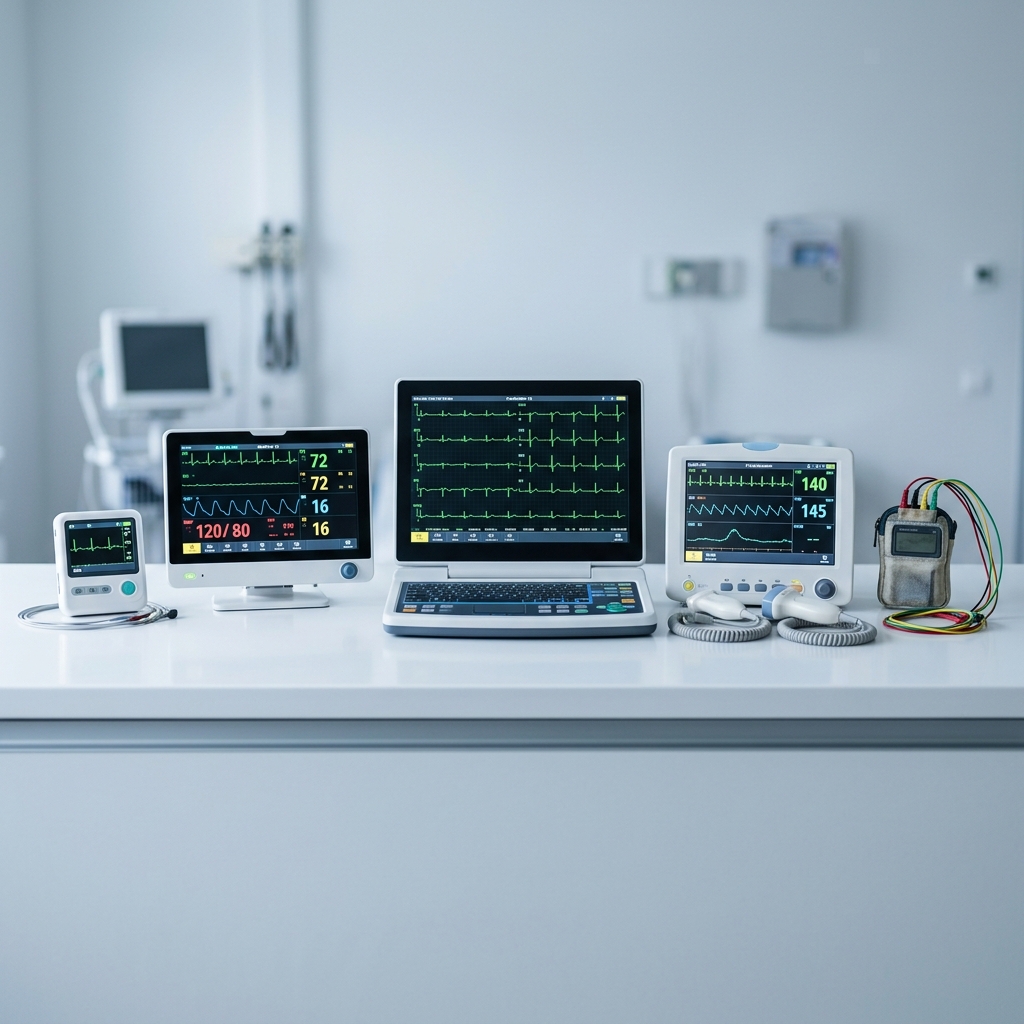
ECG, SpO2, NIBP, TEMP, RESP: the parameters that really matter
A multiparameter monitor is chosen first on monitored parameters, then on screen (size, touch, brightness), autonomy, weight, network connectivity (Wi-Fi, HL7), and expansion capability (capnography, flowmetry, fetal monitoring). In Morocco, needs fall into five segments: ICU monitor on trolley (full parameters + capno), recovery/consultation room monitor (5 parameters ECG/SpO2/NIBP/TEMP/RESP), portable for on-call or mobile ICU, fetal monitor for maternity, and quick-assessment monitor for practice. This comparison covers all five use cases with devices actually distributed in Morocco and backed by local after-sales.
1. Multiparameter Monitor MediUnit Clinical — the treatment-room standard
MU-PM-MULTI-02 is the reference 5-parameter monitor for Moroccan treatment, consultation, and recovery rooms: 3/5-lead ECG, SpO2 (Masimo SET or Nellcor depending on version), oscillometric NIBP adult/paediatric/neonatal, TEMP (skin or rectal probe), RESP (thoracic impedance). 12-inch colour TFT LCD, 4h integrated battery. French UI, HL7 connectivity for EHR.
- Morocco 2026 price: from 18,500 MAD excl. VAT (5-parameter version). Quote-based with trolley, capno, and integrated printer.
- Parameters: 5 standard (ECG, SpO2, NIBP, TEMP, RESP) + optional capnography.
- MediUnit recommendation: multi-purpose consultation room, recovery room, care unit, general private clinic.
2. ECG Monitor VITAVUE 12 — cardiology-dedicated
VITAVUE 12 (BL8310-B, available from MediUnit) is an enhanced ECG monitor: simultaneous 12-lead ECG, automatic interpretation, SpO2, NIBP, TEMP. Used in private cardiology, coronary ICU (USIC), and sports medicine. 15-inch high-resolution touch screen, backlit keyboard, 500-patient exam memory. Interfaces with HIS (HL7, DICOM). Support and after-sales in Casablanca.
- Morocco 2026 price: 38,000 – 45,000 MAD excl. VAT depending on options (printer, 2nd monitor).
- 12-lead ECG + SpO2/NIBP/TEMP. 500-patient memory.
- MediUnit recommendation: cardiology practice, coronary ICU, functional exploration, sports medicine.
3. Lepu Medical portable monitor — the on-call companion
Lepu Medical is a Chinese manufacturer specializing in compact monitors for on-call medicine, mobile ICUs, and private ambulances. LPER2 is a 3/5-lead ECG monitor with SpO2/NIBP/TEMP, pocket format (650 g, 5-inch screen). 8 h continuous battery. Used by Moroccan anaesthetists and emergency physicians on call or in emergency interventions. Wi-Fi connectivity, 48 h trend recording.
- Morocco 2026 price: 14,500 – 17,500 MAD excl. VAT.
- Weight: 650 g, 8 h battery, mains + 12V car charger.
- MediUnit recommendation: private anaesthetist, on-call emergency physician, mobile ICU, rural doctor.
4. Twin Fetal Monitor Lepu Medical LMF3G — the maternity reference
LMF3G is a twin cardiotocograph (CTG) — one of the rare models capable of monitoring two fetuses simultaneously on a single screen. Used in Level 2 and 3 maternity wards in Morocco, private obstetrics clinics, and delivery rooms. Parameters: fetal heart rate (x2), uterine contractions (Toco, 2 sensors), fetal movements. 3G battery for inter-floor transport. Continuous 24 h recording, integrated paper printout.
- Morocco 2026 price: 32,000 – 38,000 MAD excl. VAT.
- Simultaneous twin fetal monitoring + dual Toco.
- MediUnit recommendation: private maternity, Level 2/3 delivery room, obstetrics clinic.
5. Holter Monitor 12-lead Lepu Medical LPTH12 — ambulatory diagnostics
LPTH12 is a 12-lead ambulatory ECG Holter recorder for cardiac diagnostics: worn by the patient for 24–72 h, then analysed on PC with Lepu software. Its main interest in this comparison: it completes the cardiologist's or internist's diagnostic arsenal — after the consultation with VITAVUE 12, the patient leaves with the Holter for extended analysis. Recommended for palpitations, syncope, suspected arrhythmia, post-stroke therapeutic evaluation.
- Morocco 2026 price: 9,500 – 12,500 MAD excl. VAT (recorder + software + leads).
- 12 leads, 72 h battery, rechargeable.
- MediUnit recommendation: private cardiologist, internist, neurology department, pre-op assessment.
Recap: which monitor for your use
If you have a minute to decide, here is MediUnit's decision grid.
- Treatment room / multi-purpose consultation → MediUnit Clinical MU-PM-MULTI-02 (5 parameters, 12").
- Cardiology / coronary ICU / cardiac functional exploration → VITAVUE 12 (12-lead ECG + monitoring).
- On-call / mobile ICU / ambulance / field intervention → Lepu LPER2 (portable 650 g, 8 h battery).
- Maternity / delivery room → Lepu LMF3G (twin CTG, dual fetus).
- Ambulatory cardiac diagnostics → Lepu LPTH12 (12-lead Holter, 72 h).
Clinical alarm management, SpO2 sensor rotation, and patient safety in Morocco
Multiparameter monitoring in clinics or intensive care directly impacts patient survival and demands rigorous bedside discipline: 1) Combating clinical alarm fatigue: leaving alarm thresholds on factory defaults generates 80 to 90% nuisance or false alerts (motion artifacts, loose leads). Caregivers eventually mute monitor speakers or reflexively dismiss alerts without looking, creating a lethal hazard during a true apnea or ventricular fibrillation event. Always individualize alarm thresholds to each patient's baseline (e.g., tailoring SpO2 target to 88-92% for known chronic COPD patients). 2) Preventing digital pressure necrosis under SpO2 probes: in shocked, hypothermic, or vasopressor-dependent patients, leaving a rigid finger clip on the same digit for over 4 hours causes severe capillary occlusion and ischemic pressure necrosis. Rotate probe sites every 4 hours. Be mindful that dark nail polishes and traditional henna—frequently encountered in Moroccan clinical practice—interfere with red/infrared light absorption and generate falsely depressed saturation readings. 3) NIBP automated cuff safeguards: NEVER apply an automated cycle cuff to an extremity hosting an active peripheral IV infusion (risk of venous stasis and thrombophlebitis) or an arteriovenous fistula (AVF) in dialysis patients.
- Customize alarm thresholds: eliminate alarm fatigue to guarantee immediate response to genuine arrhythmias.
- Rotate SpO2 probe every 4h: prevent digital pressure necrosis; account for henna and dark polish optical interference.
- Automated NIBP safety: never inflate cuff on an extremity with active IV line or arteriovenous fistula (AVF); ar: أمان حزام الضغط التلقائي: تجنب القياس على ذراع بها قسطرة مغذي نشطة أو ناسور غسيل الكلى.
Request a MediUnit quote
MediUnit issues a side-by-side monitor comparison quote with two or three models (price, parameters, screen, battery, after-sales) within 24h. Specify your specialty, use location (treatment room, mobile ICU, maternity, home), required number of parameters, and whether you need a trolley, printer, or EHR connection. Demo available in Casablanca, Rabat, or Marrakech for budgets > 25,000 MAD excl. VAT.
Patient monitors category
Abdelrhafar Naouri
Clinical Director & Medical Sourcing Expert
With over 15 years of experience managing clinical facilities and medical equipment sourcing in Morocco, Abdelrhafar Naouri guides healthcare professionals in securing regulatory-compliant medical supplies under Ministry of Health (DMP) standards.
Actions
Next step
Move from content to execution: open a structured quote, browse brands, or activate the client portal to centralize orders and documents.